Google’s Review Reply Rejection Filter: What 12,752 Rejected Replies Reveal
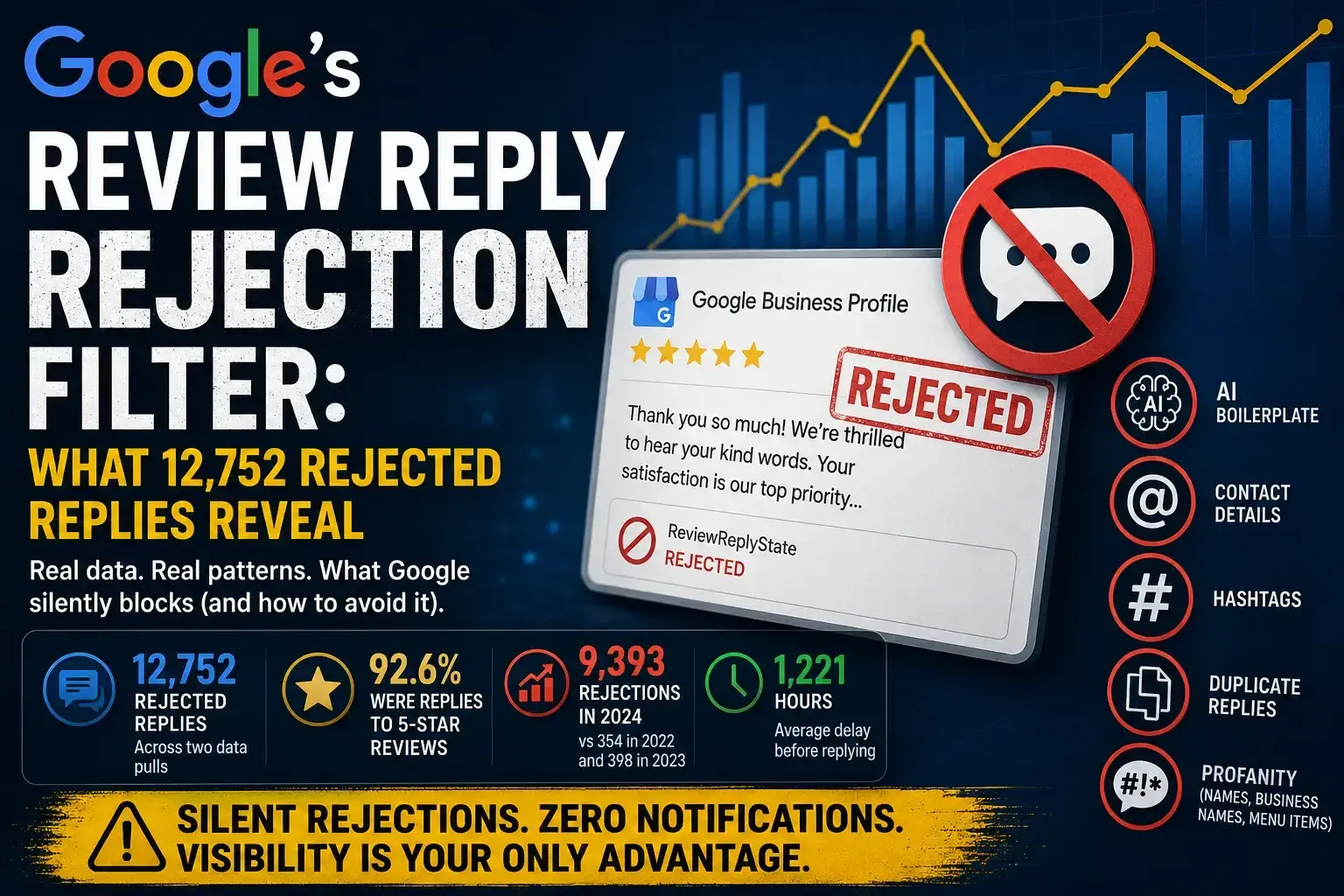
Google now silently rejects review replies. No notification. No explanation. Your reply sits in a REJECTED state in the API while you assume it went live.
We know this because we can see it. The Google Business Profile API introduced ReviewReplyState on April 1st 2026 (Google Dev Change Blog). Before that, every reply posted via the API went live automatically. No moderation. No filter.
That changed. And with it came a silent rejection problem that most businesses and agencies have no idea they’re experiencing.
We pulled 12,752 rejected review replies from our platform data across two separate extractions, one immediately after the data became available on 22 April 2026, and a second on 28 May 2026, to find out what’s actually triggering Google’s filter. This is the first time this data has been published. Here’s what we found.
The Scale of the Problem Is Larger Than Anyone Realises
In our combined dataset of 12,752 rejected replies:
92.6% were replies to 5-star reviews. Positive reviews are generating the most rejections, almost certainly because businesses (and AI tools) respond to them with templated, enthusiastic language.
Rejections spiked sharply in 2024. From 354 rejections in all of 2022 and 398 in 2023, the number jumped to 9,393 in 2024 alone. Either Google’s filter clearly became significantly more aggressive, Google or the quality of the review changed.
The average rejected reply was written 1,221 hours, roughly 50 days, after the original review was posted. Delayed, bulk-scheduled replies appear in the data at a disproportionate rate, and that average has grown since our first pull. The silent nature of this is the core problem. A reply that gets rejected doesn’t generate an error. It doesn’t bounce back. It simply doesn’t appear. Without API-level visibility, you’d never know.
Two Snapshots, One Story
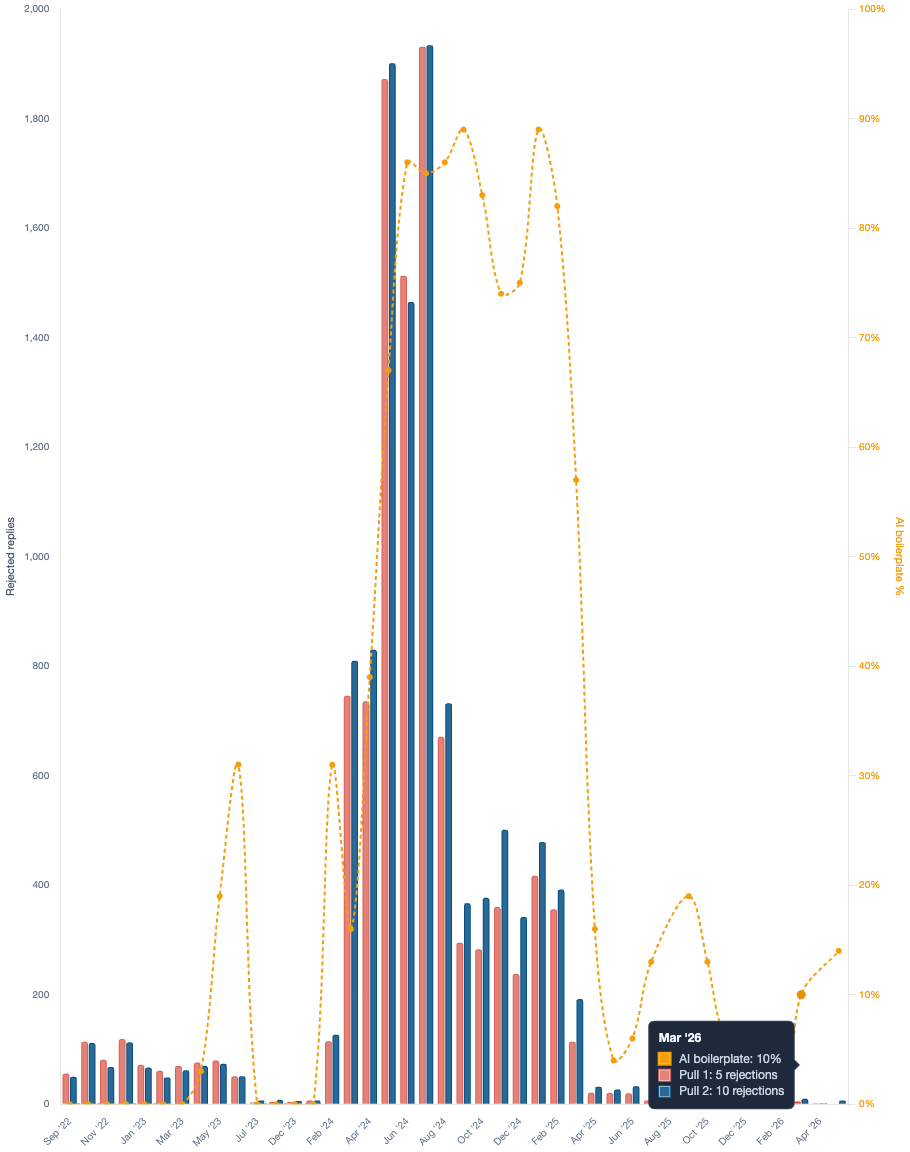
The chart below plots monthly rejection counts from both data pulls. The first extraction (22 April 2026, shown in light blue) captured 7,151 rejected replies. The second extraction (28 May 2026, shown in solid blue) identified 12,752, a 78% increase in just five weeks, reflecting both new rejections and historically rejected replies that had not yet been indexed in our first pull.
The amber line tracks the percentage of rejected replies in each month that contain detectable AI boilerplate language. Its trajectory is the central finding of this analysis.
The two datasets tell a consistent story: a flat baseline through 2022–2023, an explosive spike in 2024, and a sharp compositional shift from mid-2025 onwards, in which volume drops while the character of what remains changes significantly.
Reason 1: AI Boilerplate Is the Single Biggest Trigger
67% of all rejected replies in our dataset contained at least one detectable AI boilerplate phrase. The proportion rose from roughly 35% in early 2024 to 85% by mid-2024, where it held through early 2025.
The phrases that appear most frequently in rejected replies are precisely the ones produced by unconfigured or generic AI reply tools:
Phrase | Appears in rejected replies |
|---|---|
"thrilled to hear" | 48.7% |
"your kind words" | 31.0% |
"thank you for your kind" | 20.4% |
"look forward to serving you" | 19.5% |
"welcoming you back" | 14.8% |
"we strive to" | 9.1% |
"feel free to" | 6.6% |
"your satisfaction is our" | 5.8% |
These phrases don’t just appear in rejected replies; they dominate them. This is not a correlation. The pattern is too consistent, and the timeline too precise, to be coincidental.
Our hypothesis: Google’s moderation system has built a statistical model of low-quality, automated review responses. The phrases above are the fingerprints of mass AI generation. They appear in millions of replies across billions of businesses at an unnatural frequency. Google’s filter appears to flag replies that combine these signals into a recognisable template pattern.
Think of it as a spam filter. Individual words aren’t the problem. The combination, “opener + name + compliment phrase + satisfaction line + forward-looking closer”, is the pattern Google has learned to reject.
Here’s a real example from our data (a 5-star plumbing review reply, 1,731 characters, immediately rejected):
“Hello Tannas, Thank you for your glowing review and for highly recommending Kingstree Plumbing! We are incredibly grateful for your endorsement… It’s wonderful to hear that Dane’s informative, efficient, and friendly approach made such a positive impact… Your feedback is invaluable to us… #KingstreePlumbing #HighlyRecommended #EfficientService…”
This reply contains hashtags, keyword stuffing, excessive length, AI-style praise phrases, and reads as if it were generated by a tool with no guardrails. It was rejected immediately.
The lesson: if your AI reply tool produces responses that sound like every other AI reply tool, Google’s filter will eventually catch up with it.
Reason 2: Profanity in Names, Business Names, and Menu Items
This one surprises people. Google’s profanity filter operates on the full text of the reply, but it cannot distinguish between a slur and a context where the same string is legitimate.
The problem manifests in three distinct forms.
Reviewer names
In our dataset, we found 90 replies rejected because a reviewer’s name contained a string that Google’s filter reads as offensive language. The most common case involves reviewers named “Dick”, a common given name in the Netherlands. A Dutch business replying naturally with “Beste Dick, dankjewel voor je review…” will have that reply rejected. The business did nothing wrong. The filter doesn’t make contextual judgements. We also found cases involving the Dutch name “Cock” (short for Cornelis), the Vietnamese username “TÍT TV,” and a reviewer named “Ass Wipe”, a clearly fake account, where the business replied professionally by first name (“Thank you, Ass, for highlighting our team’s professionalism…”) and was blocked.
Business names
The second form is more difficult to work around. Burger Bitch is a restaurant in our dataset. Their team naturally signs off replies with “Groetjes, team Burger Bitch” or “Glad you liked it! Greets team Burger Bitch.” Every one of those replies is rejected. The business cannot mention its own name in a review reply without triggering the filter. We counted 22 rejected Burger Bitch replies in the dataset, all of them professionally written, none of them offensive in any meaningful sense.
Menu and product names
The third form appears when businesses acknowledge something a customer mentioned in their review. One rejected reply referenced the customer’s order of a “Pastrami Orgy”, a menu item. Another mentioned that the customer had enjoyed a “Pornstar Martini” cocktail, a completely standard drink. Both replies were rejected for containing strings that the filter treats as explicit content, regardless of culinary context.
The practical rule: before your reply tool posts a response, it should run a pre-flight check against the full text, including the reviewer’s name, any product names, and the business signature. If any string could trigger an automated profanity filter, the reply needs human review before it is submitted.
Reason 3: Exact Duplicate and Minimum-Content Replies
In the data, one account submitted the reply “Thank you!”, ten characters, verbatim, to over 100 consecutive reviews. All were rejected. Another account sent “thank you for a good review” identically to 46 reviews in sequence. A third pattern: “Thank you 🙏” with only the reviewer’s first name appended, sent hundreds of times across an account.
At the extreme end: rejected replies consisting solely of a single emoji “👍”, “🙌”, “😊”, or just punctuation marks like “!!!” or “.”.
Two mechanisms are likely operating here. First, exact duplication at scale is a textbook spam signal. When the same string is submitted from the same account to dozens or hundreds of reviews in a short window, that pattern matches known low-quality automation behaviour regardless of whether the individual string is offensive. Second, Google appears to enforce a minimum-quality threshold. A reply that adds no informational value to the public record, “Thank you!” contributes nothing a reader couldn’t infer from the star rating, and may fail a quality floor that the moderation system applies before a reply is approved.
The practical implication: templating isn’t just a boilerplate-language problem. Even a short, clean, non-AI reply will be rejected if it is identical to dozens of other replies from the same account.
Reason 4: Contact Details in the Reply Body
Review replies are not a channel for driving traffic or capturing leads. Google’s content policy makes this clear, and our data reflects it.
327 replies (2.6%) contained an email address embedded in the reply body. These are almost always a well-intentioned attempt to resolve a complaint: “Please contact us at [email protected] so we can make this right.”
287 replies (2.3%) included “contact us” or “call us” language, directing the reviewer to take action outside the platform. The pattern is consistent with negative and neutral reviews, where businesses instinctively want to move the conversation offline.
Google’s position is straightforward: a review reply should address the reviewer publicly. If you want to follow up privately, use Google’s existing private messaging feature. Embedding your support email in a public reply is treated as a commercial or off-platform solicitation, and it gets blocked.
Reason 5: Hashtags in Reply Text
38 replies in our dataset contained hashtags, and all 38 were rejected. Hashtags are a feature of social media platforms where discovery is driven by tagging. Google Business Profile reviews are not social media. They’re a structured trust signal.
The rejected hashtag example from our data makes the problem clear: #KingstreePlumbing #HighlyRecommended #EdmontonAreaExperts
This reads as SEO manipulation, stuffing business names and location terms into a reply to game local search signals. Whether or not that was the intent, Google’s filter reads it that way.
The rule is simple: no hashtags in review replies.
Reason 6: Bulk Scheduling and Reply Velocity
Response time alone doesn’t cause rejection. But it is a component of the broader pattern Google appears to be analysing.
78.7% of rejected replies in our dataset were posted more than 24 hours after the review was written. The average delay was 1,221 hours, roughly 50 days, up from 720 hours in our first pull. This reflects the behaviour of businesses that batch their replies, often running bulk AI generation once a week or once a month rather than responding in real time. That average is getting worse, not better.
When the same account submits a large volume of replies in a short window, all following the same structural template, that pattern is consistent with automated abuse. It is the digital equivalent of sending 500 emails from the same IP in one hour, technically legitimate, but statistically suspicious.
Our hypothesis on bulk scheduling: Google’s system may not evaluate a reply in isolation. It may evaluate it in the context of velocity, how many replies this account has submitted in this window, how structurally similar those replies are, and whether the pattern matches known low-quality automation behaviour. This is harder to prove from the reply text alone. But the timing data, combined with the boilerplate and duplication data, points strongly in this direction.
What Google's Content Policy Actually Prohibits
Google’s stated policies for review replies are broad and not comprehensively documented. Based on our data and the API documentation, the following content categories carry the highest rejection risk:
Definite causes:
- Profanity or offensive language (including in reviewer names, business names, and product names incorporated into the reply)
- Email addresses
- Hashtags
- Exact duplicate replies submitted at scale from the same account
- Replies below a minimum quality or content threshold (single emoji, “Thank you!” alone)
Strong hypotheses based on our data:
- Templated AI boilerplate (the dominant cause, 67% of all rejections)
- Bulk velocity patterns from a single account
- Keyword stuffing or SEO manipulation within the reply text
- Replies exceeding an undocumented length threshold (the longest rejected reply in our data was 1,731 characters)
Lower risk, but worth monitoring:
- Mixed-language replies where content flags in one language but not another
- Emoji-heavy replies, particularly in combination with very short text
- The Timeline: When the Filter Changed and How It Evolved
The data tells a clear story across two phases.
Phase 1: 2024 to early 2025. The AI boilerplate epidemic. Before 2024, rejections in our dataset were minimal: 354 in 2022, 398 in 2023. Starting in March 2024, rejections began accelerating sharply. By May 2024, over 70% of all rejected replies contained AI boilerplate. By July 2024, that figure reached 85% and held there through February 2025.
The timing correlates precisely with the mass adoption of AI-powered review reply tools. As the volume of AI-generated replies increased across the Google ecosystem, Google’s moderation system appears to pick up on the patterns those tools produce. This is the core dynamic: AI tools created a boilerplate epidemic. Google responds with a boilerplate filter (two years later).
Phase 2: April 2025 onwards. A different rejection profile. From April 2025, the AI boilerplate share of rejections drops sharply from above 70% to single digits in some months. Total rejection volume also falls significantly.
Two interpretations are possible, and both may be partially true. Either the AI-powered review reply tools became sophisticated enough that businesses stopped using those poor quality templates (so fewer boilerplate replies are being submitted). Or Google applies the filter to intercept boilerplate at a particular stage of the Review Reply age, before it reaches a formal REJECTED state. This is unlikely. Google might not use the Review Replies for AI entity and contextual profiling in the first year of the review, or to a lesser extent. What remains in the late-2025 and 2026 data is a different compositional profile: primarily profanity-in-context cases, exact duplicate spam, and minimum-content replies, the categories covered in Reasons 2, 3, and 6 above.
What This Means for Your Review Reply Strategy
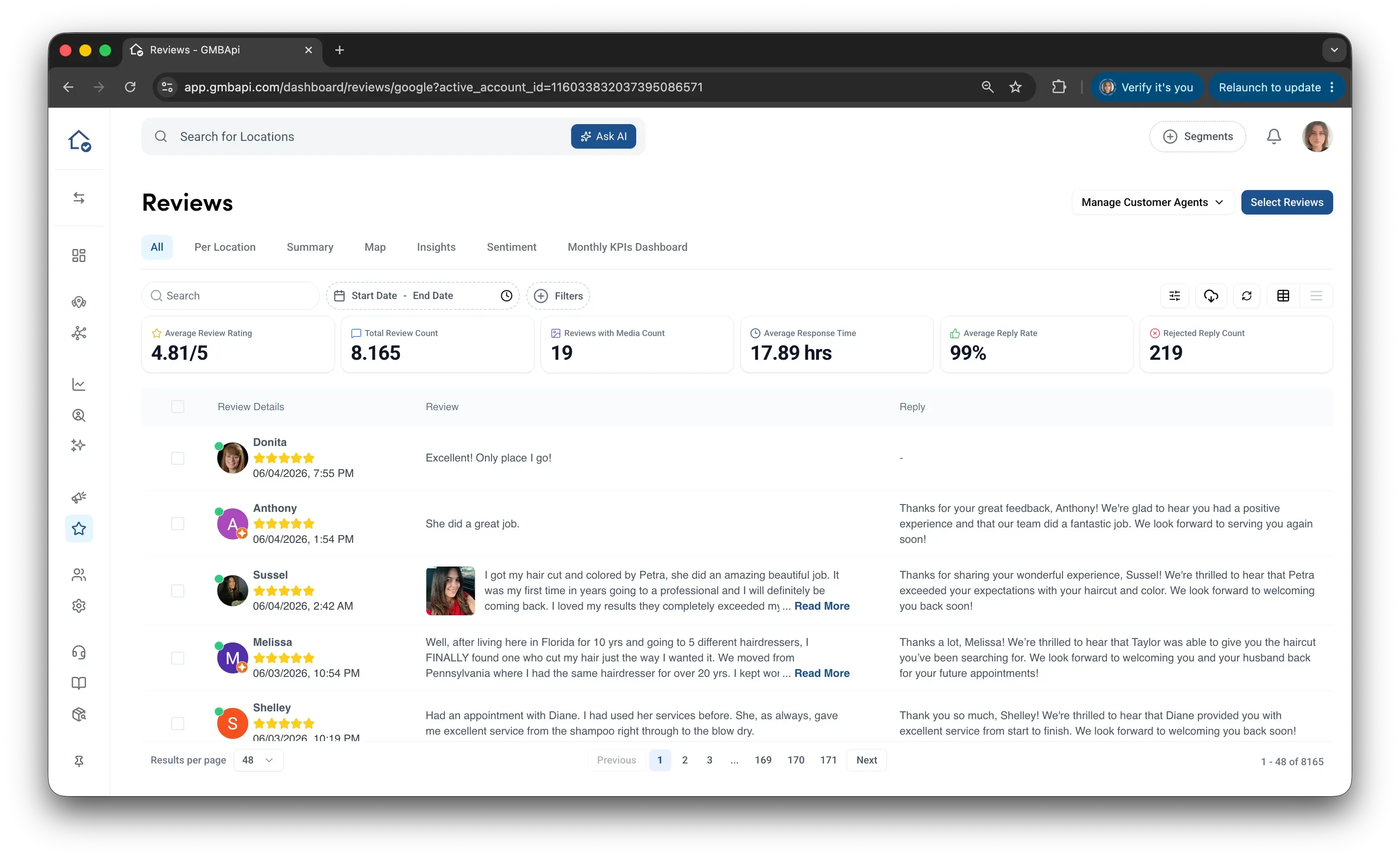
Check your current reply state. If you’re posting via the API, you need visibility into ReviewReplyState. Replies posted via the Google Business Profile UI or third-party tools that don’t surface this field are operating blind. A small percentage of your existing replies may already be in a REJECTED state to keep ahead of the filters, follow these 5 steps:
- Audit your AI reply tool. If it produces replies that include “we’re thrilled to hear,” “your satisfaction is our top priority,” or “we look forward to welcoming you back,” it is generating high-rejection-risk content. These phrases are statistical markers of low-quality automation. Retrain or reconfigure the tool with more specific, contextual, and varied language.
- Run a pre-flight profanity check on the full reply text. This includes the reviewer’s name, any product or menu items referenced, and your business name in the sign-off. Google’s filter doesn’t understand context. “Pornstar Martini” is a cocktail; the filter sees two flagged strings.
- Eliminate exact duplicate templates. If your tool is sending identical replies across multiple reviews, that pattern is a direct rejection signal regardless of content quality. Every reply should vary, even if the variation is minor.
- Strip contact details from templates. Any template that includes your email address, phone number, or “contact us” language needs to be revised. Address complaints with a general offer to connect, not a direct call to action with contact information embedded.
- Distribute replies across time. If you’re scheduling 200 replies to go out at 9 am on Monday, that pattern is detectable. Spread replies across time windows and aim to reply within 24 hours of the review being posted.
The Visibility Gap Is the Real Problem
Most businesses don’t know their replies are being rejected. That’s the harder issue.
There’s no email from Google. There’s no flag in the Business Profile dashboard. The reply simply doesn’t appear publicly, while internally it sits in a REJECTED state that only the API can surface. For any business relying on third-party tools that don’t expose this field, the problem is entirely invisible.
This is why API-level access to ReviewReplyState isn’t a technical detail; it’s an operational requirement. Without it, you’re publishing into a black box.
At GMBapi.com, ReviewReplyState is surfaced for every reply. When a reply is rejected, the platform flags it, so it can be reviewed, corrected, and resubmitted. The underlying data that produced this article came directly from that monitoring infrastructure, pulled across two extractions five weeks apart.
The goal isn’t to tell you what not to do. It’s to make the invisible visible.
FAQ About our Analysis
Google rejects review replies that violate its content policies or trigger its automated moderation filter. The most common causes, based on our analysis of 12,752 rejected replies, are AI-generated boilerplate language (present in 67% of rejections), profanity in the reply text (including strings from reviewer names, business names, and product names), exact duplicate replies submitted at scale, embedded contact details, and hashtags.
No. There is no notification via email or the Google Business Profile dashboard. The only way to detect a rejected reply is through the Google Business Profile API, which returns a ReviewReplyState field with the value REJECTED. Businesses without API access have no way to know if their replies are being blocked.
Yes. A rejected reply can be edited and resubmitted. If the content that triggered the rejection is removed or revised, the new version will go through the moderation process again. There is no documented limit on resubmissions.
Google’s published policy does not explicitly prohibit AI-generated replies. However, our data strongly suggests that Google’s moderation system flags replies containing common AI boilerplate phrases at a significantly higher rejection rate. The practical effect is that poorly configured AI tools produce replies that trigger automated rejection.
This is a documented problem in our data. Businesses whose names contain flagged strings such as Burger Bitch cannot include their own name in a reply without triggering rejection. The current workaround is to omit the business name from the reply sign-off, or to use an abbreviated or alternative
Our data covers replies from businesses managed at scale via the API, so it skews towards larger multi-location operators and the agencies managing them. The pattern of AI boilerplate rejection is likely to apply equally to any business using an AI reply tool, regardless of size.
Our data doesn’t point to a clear safe length, but both extremes carry risk. The longest rejected reply was 1,731 characters. Replies of fewer than 50 characters were rejected at a rate of 7.3%, with the pattern concentrated in businesses submitting “Thank you!” and single-emoji replies at scale. Replies between 100 and 500 characters that avoid boilerplate phrases, contact details, hashtags, and duplicate content appear to carry the lowest rejection risk.
Share this article
Keep reading
More news, trends, and how to guides
Start growing with GMBapi.com
Leverage AI to manage reviews, bulk publish content while ensuring consistency across all your local platforms. Stay ahead by monitoring competitors & showcasing what makes you stand out.